ETL vs ELT: differences, examples, and when to use each approach
ETL and ELT are two ways to design a data pipeline. Learn their differences, when to use each one, and how they fit into modern architectures.
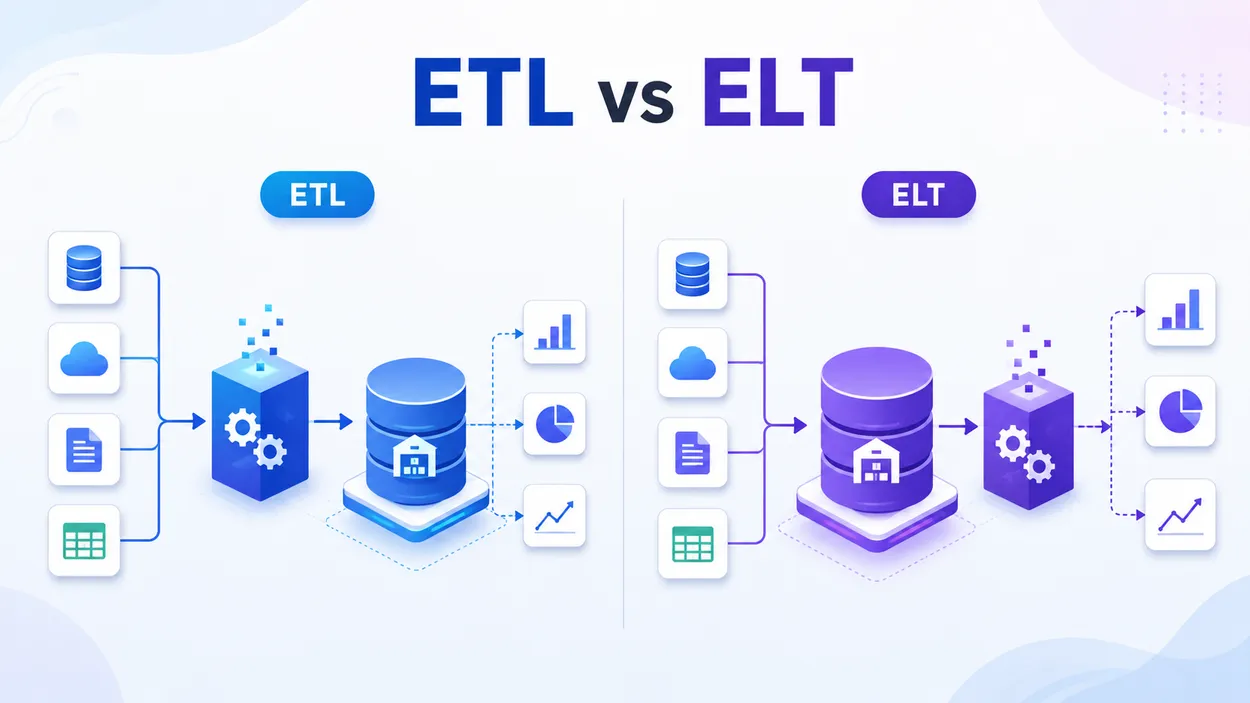

The comparison between ETL and ELT is often presented as a terminology issue, but it actually describes two different ways to design a system for moving and preparing data. The difference is not only the order of three letters. It changes where transformations are applied, what kind of infrastructure is needed, how processing scales, and above all, how an organization preserves and uses its data.
To understand that difference properly, it helps to start with the technical problem. A company generates data in many systems: transactional applications, APIs, files, logs, SaaS tools, or relational databases. That data rarely arrives ready for analysis. It usually contains inconsistent formats, duplicates, null values, unapplied business rules, or structures that are incompatible with each other. That is why a data pipeline is needed: a controlled flow that extracts information from its sources, prepares it, and makes it available for analysis, reporting, or consumption by other systems.
In that context, ETL and ELT are two strategies for solving the same problem. Both extract data from a source and move it to a target system. The difference is when and where the information is transformed. That nuance, which looks small on paper, has important architectural consequences.
What does a data pipeline actually do?
A data pipeline is a sequence of processes that moves data from one or more source systems to a destination system where it can be queried, joined, or reused. In a modern environment, that destination is usually a data warehouse or a data lake. A data warehouse is a storage system optimized for analytical queries. A data lake prioritizes large-scale storage of raw or semi-structured data.
The pipeline is not limited to copying information from one place to another. Its real purpose is to turn operational data into usable data. At minimum, that involves four layers of work:
- Extraction. Getting data from databases, external services, internal applications, or files.
- Loading. Moving that data into a centralized environment.
- Transformation. Cleaning, typing, enriching, deduplicating, or modeling the data.
- Exposure. Leaving the result ready for dashboards, analysis, predictive models, or consumption by other applications.
The ETL vs ELT discussion mainly affects the third layer. It does not question whether data needs to be transformed, but when in the flow it should happen and which system should take on that workload.
What ETL is and how it is structured
ETL means Extract, Transform, Load.
In this approach, data is extracted from source systems, processed in an intermediate environment, and only then loaded into the destination system. The idea is that the final storage receives a dataset that is already clean, validated, and structured according to defined rules.
The logical structure of an ETL system usually includes these components:
- Data sources: relational databases, APIs, CSV files, ERP, CRM, or SaaS applications.
- Transformation engine: scripts, scheduled jobs, or specific tools that apply cleaning and normalization rules.
- Staging environment: a temporary area where data is prepared before final loading.
- Destination system: usually a data warehouse with tables already modeled for analysis.
From a technical point of view, ETL works well in environments where the final system should not receive raw data or where prior validation is mandatory. It is common in traditional BI architectures, on-premise systems, and contexts where control over data quality is applied before persistence.
In practice, this approach follows a clear logic: if I know exactly what structure I need and I want to make sure only cleaned information reaches the analytical system, I transform first and load later.
A simplified example can be seen in a small ETL process built with Python and pandas. First the data is extracted, then it is cleaned and transformed, and finally it is loaded into the destination system:
import pandas as pd
from sqlalchemy import create_engine

# connection to source and destination databases
source_engine = create_engine("postgresql://source_db")
target_engine = create_engine("postgresql://warehouse")

# Extract
orders = pd.read_sql("SELECT order_id, amount, country FROM orders", source_engine)

# Transform
orders = orders.dropna(subset=["order_id"])
orders["amount_eur"] = orders["amount"] * 0.93
summary = orders.groupby("country", as_index=False)["amount_eur"].sum()

# Load
summary.to_sql("sales_by_country", target_engine, if_exists="replace", index=False)
In this flow, the analytical database only receives the final transformed result. All cleaning, aggregation, and calculation logic happens before loading.
What ELT is and why it changes the architecture
ELT means Extract, Load, Transform.
Here the operational order is reversed. Data is extracted from the sources and first loaded into the destination system, usually a cloud data warehouse. Transformations are executed later, inside that same system, taking advantage of its compute capacity.
The rise of ELT is not a theoretical preference; it is a consequence of changes in available infrastructure. Platforms such as Snowflake, BigQuery, or Redshift can store large volumes of information and execute analytical transformations directly on the destination engine. This reduces the need for an external system dedicated exclusively to preparing data before loading it.
The structure of an ELT system usually relies on these elements:
- Connectors or ingestion processes to extract data from sources.
- Raw zone or landing layer inside the warehouse, where data is preserved as it arrives.
- Transformation layer usually implemented with SQL, analytical models, or tools such as dbt.
- Consumption layer with tables already modeled for business, reporting, or data science.
The most relevant technical consequence is that ELT makes it possible to preserve both the original data and its transformed derivations. That provides more flexibility to rebuild models, debug problems, or reuse information for different purposes without extracting everything again from the source.
A typical example in an ELT architecture would be to load raw data into the warehouse first and apply transformations later with SQL:
-- Data first arrives in a raw table
SELECT *
FROM raw.orders;
Then transformed models are created inside the warehouse itself:
CREATE OR REPLACE TABLE analytics.sales_by_country AS
SELECT
    country,
    SUM(amount * 0.93) AS amount_eur
FROM raw.orders
WHERE order_id IS NOT NULL
GROUP BY country;
Here the warehouse acts both as a data repository and as a transformation engine. The original data remains available in the raw layer, while analytical tables are generated as later derivations.
The real difference between ETL and ELT
At a superficial level, the difference between ETL and ELT is the order of the letters. At an architectural level, the real difference is this: which system takes on the cost of transforming the data and at what stage of the pipeline the raw data is lost or preserved.
In ETL, transformation happens before loading. The final storage system receives already processed data. That simplifies the final model, but limits the ability to inspect the original data if it has not been preserved somewhere else.
In ELT, loading happens before transformation. The destination system acts as a raw data repository and as a transformation engine. This offers more analytical flexibility, but requires discipline in modeling, versioning, and compute cost control.
In other words, ETL prioritizes upfront control. ELT prioritizes the ability to process and reinterpret data after it has been stored.
Technical comparison: ETL vs ELT
| Aspect | ETL | ELT |
|---|---|---|
| Flow order | Extract → Transform → Load | Extract → Load → Transform |
| Transformation location | Intermediate system or ETL engine | Inside the data warehouse |
| Data state when it reaches destination | Already cleaned and structured | Raw or semi-processed data |
| Preservation of original data | Not always | Usually yes |
| Warehouse dependency for transformation | Low | High |
| Scalability | Limited by the ETL engine | Aligned with warehouse compute |
| Flexibility to rebuild models | Lower | Higher |
| Fit for legacy environments | High | Medium |
| Fit for cloud architectures | Medium | High |
This table summarizes the operational differences, but it should not be read as a hierarchy. ELT does not automatically replace ETL in every case. The right choice depends on the technical context of the system.
When ETL makes sense
ETL remains a reasonable choice when prior transformation is not optional, but part of the system’s control layer. This happens in several scenarios.
The first is when the destination must not store unvalidated data. If an organization needs to ensure that all loaded information follows strict rules before it is persisted, ETL makes it possible to filter and normalize from the beginning.
The second is when the destination system is not designed to handle complex transformations. This is still common in legacy environments or on-premise architectures with limited resources.
The third appears when data volume is moderate and the model is well defined in advance. In that case, an ETL flow can be easier to govern and more predictable.
In my experience, this approach appears naturally in pipelines built with Python and pandas when the goal is to consolidate several relational sources, apply clear cleaning rules, and deliver a dataset that is already ready for consumption. In those cases, ETL is not only valid; it is often the most direct option.
When ELT makes sense
ELT fits better when the destination system has enough compute capacity and when it is useful to preserve as much information as possible before deciding how to model it.
This is especially relevant in modern architectures based on Snowflake, BigQuery, or similar platforms. In these environments, loading first and transforming later makes it possible to decouple ingestion from modeling. That separation simplifies system evolution: data reaches a raw layer, is then structured in stages, and is finally published into business-ready models.
ELT also has an advantage when transformation rules change frequently. If the raw data is already stored, rebuilding a model is easier than extracting again and reconstructing the entire pipeline from the source.
In my case, this pattern makes a lot of sense when the warehouse is Snowflake and most transformations can be expressed in SQL or later analytical layers. The important point is not only that the system scales better, but that the architecture gains traceability: it is easier to see what arrived, what was transformed, and what result each step produced.
How both approaches fit into a modern pipeline
A modern pipeline is rarely a single piece. It is usually composed of several layers with different responsibilities: ingestion, raw storage, intermediate transformation, final modeling, and exposure.
In that context, ETL and ELT should not be understood as closed labels, but as dominant strategies within the flow. A system can be mainly ELT and still include small transformations before loading. Similarly, an ETL process can rely on the warehouse for some later derivations.
The important question is to identify where the main system logic happens. If most business rules, typing, joins, and modeling are executed in the warehouse, the architecture is ELT-oriented. If all of that happens before loading the final data, the dominant logic is ETL.
From a design perspective, it is useful to think about the pipeline as a chain with three separate decisions:
- How I ingest the data.
- Where I persist it initially.
- Where and how I apply transformations.
ETL and ELT mainly affect the third decision, but they also condition the other two.
How many modern pipelines are structured (raw, staging, marts)
In modern data architectures, especially when an ELT approach is adopted, it is common to organize the warehouse into several logical layers. This pattern helps separate responsibilities and makes it easier to understand what happens to the data at each stage of the process.
A common way to structure these layers is the following:
1. Raw layer (or landing)
This is where data is stored as it arrives from the sources. No complex transformations are applied; the main goal is to preserve a faithful copy of the original data.
For example:
- tables replicated from operational databases
- data ingested from APIs
- events or logs
This layer makes it possible to audit what data actually reached the system and to process it again if the analytical model changes.
2. Staging layer
This is where the first systematic transformations begin. The goal is not yet to produce final models, but to prepare the data so it can be combined with other sources.
Typical tasks in this layer include:
- column typing
- format normalization
- duplicate removal
- name standardization
In many teams, these transformations are implemented with SQL or analytical modeling tools such as dbt, which make it possible to version transformation logic as if it were code.
3. Marts or analytics layer
The last layer contains business-oriented models. This is where the tables actually used by analysts, dashboards, or machine learning models appear.
Typical examples:
sales_by_countrydaily_active_userscustomer_lifetime_value
These tables are usually built by combining several sources already prepared in staging and applying more complex business rules.
This layered approach does not belong exclusively to ELT, but it fits especially well with it. By loading raw data into the warehouse first, these layers can be built progressively without extracting again from the source.
From an engineering point of view, this separation provides several advantages:
- traceability: it is easy to follow the path of the data from source to final model
- reproducibility: models can be rebuilt from the raw layer
- maintainability: each layer has clear responsibilities
That is why many modern pipelines are not described only as ETL or ELT, but also by the layer structure they use inside the analytical system.
Common mistakes when comparing ETL and ELT
One of the most common mistakes is presenting ELT as an evolution that makes ETL obsolete. That idea is incomplete. ELT has gained weight because cloud infrastructure has changed the relative cost of storage and compute, but that does not eliminate the cases where transforming first is still the right decision.
Another frequent mistake is reducing the comparison to a pros-and-cons table without explaining the type of data, the size of the system, or the analytical destination. Without that context, the comparison becomes abstract and ends up being less useful.
It is also common to mix technical discussion with tool discussion. Tools such as Airflow, dbt, Fivetran, or Talend participate in different parts of the flow, but they do not define by themselves whether an architecture is ETL or ELT. What defines it is where the main transformation happens.
I have also seen a recurring issue in small pipelines that grow quickly: starting with simple pandas scripts, assuming that pattern will scale unchanged, and ending up concentrating too much logic in a single point of the process. While volume is low, it can work. When sources, dependencies, and execution times increase, it is worth reviewing whether the architecture still makes sense or whether part of the logic should move to the warehouse.
Which approach to choose
The decision between ETL and ELT should not be made because of trends, but because of technical fit.
If you work with relatively controlled sources, moderate volume, stable rules, and a need to validate before persistence, ETL remains a solid option.
If you work with a powerful cloud data warehouse, need to preserve raw data, want to rebuild transformations frequently, or prefer to decouple ingestion and modeling, ELT usually offers a more flexible architecture.
The useful question is not which one is better in the abstract, but this: where does it make the most sense to apply the main transformation of my data, given my systems, my volume, and the way I use the information.
That question forces you to look at the real architecture, not just the acronyms.
Conclusion
ETL and ELT describe two ways of organizing a data pipeline. Both extract information from different sources and make it ready for analysis, but they place transformation in different parts of the system.
ETL concentrates preparation before loading and favors greater upfront control over what enters the analytical repository. ELT moves that logic into the data warehouse and uses the destination’s compute capacity to transform after storage.
In practical terms, the choice depends on three variables: the type of infrastructure available, the level of control you need before persisting data, and the flexibility you want to preserve for remodeling information later.
That is why understanding ETL vs ELT properly is not about memorizing the acronyms. It is about reading them as an architectural decision.
FAQ
Is ETL obsolete?
No. It has lost prominence in some cloud environments, but it is still useful when prior validation is mandatory, when the destination must not store raw data, or when the final infrastructure is not designed to transform large volumes.
Is ELT always better in Snowflake or BigQuery?
Not always, although it often fits better. These platforms make the ELT approach easier because they allow data to be loaded quickly and transformed later with good performance. Even so, some prior transformations may be necessary for quality, security, or compatibility.
Is the difference between ETL and ELT only the order of the phases?
Formally yes, but technically no. That change in order redefines where the system logic lives, what data is preserved, which component supports compute, and how the pipeline evolves over time.
Can I mix ETL and ELT in the same architecture?
Yes. In fact, it is quite common. Many modern architectures load raw data into the warehouse, but apply some prior transformations at the source or in an intermediate layer when specific constraints exist.
What tools usually appear in this kind of pipeline?
It depends on the system. It is common to see orchestrators such as Airflow, ingestion connectors such as Fivetran or Stitch, transformation engines such as dbt, and programmatic processing with Python, pandas, or SQL. The tool does not define the approach by itself; the place where the data is transformed does.
Related Posts
Roger Bosch
•May 18, 2026
Roger Bosch
•May 18, 2026